
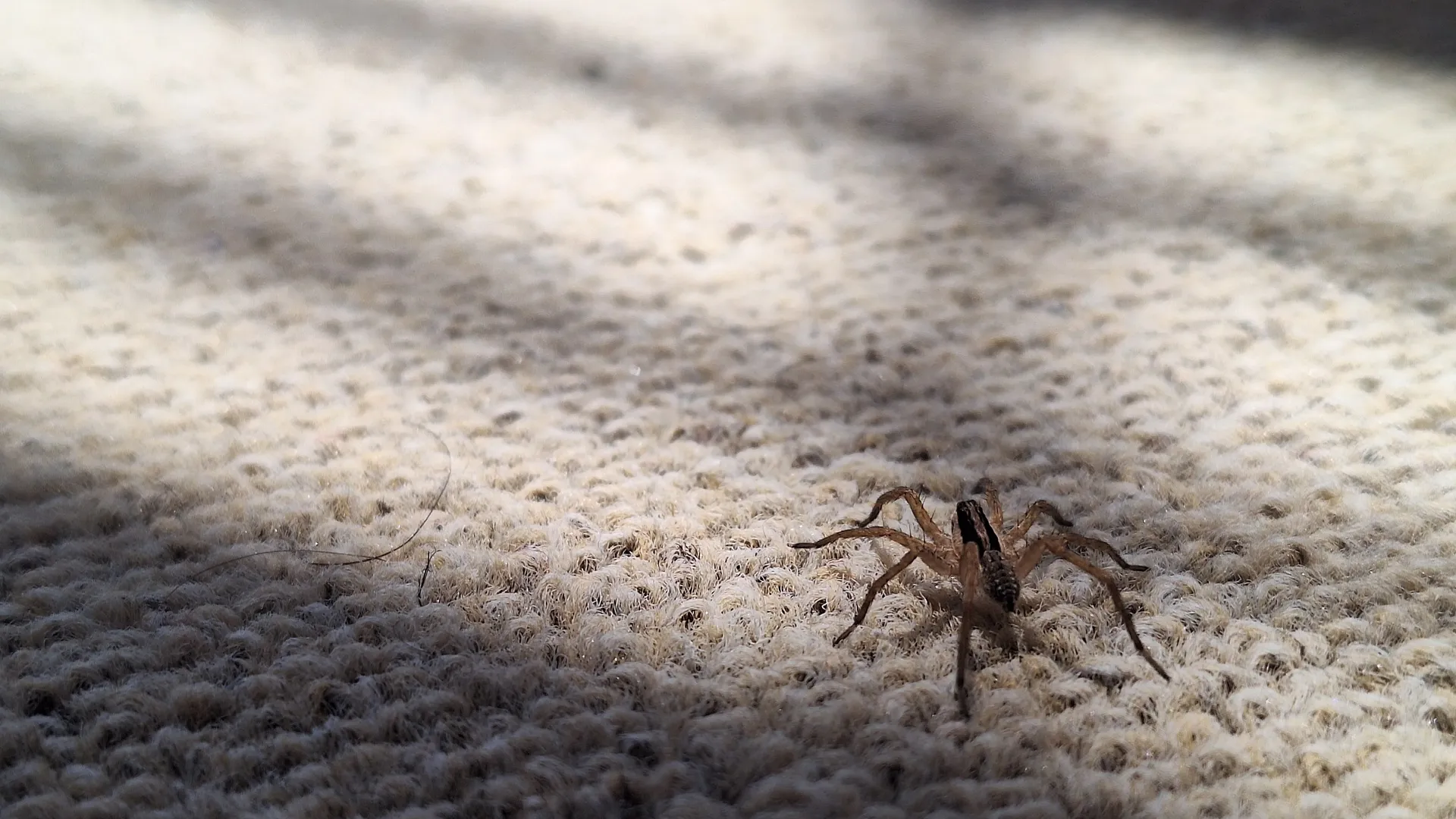
Wolf spiders come into your house because they're hunting, not because they want to live with you. They don't build webs; they chase down other insects, so seeing one indoors usually means there's prey inside or right around the foundation, and fall is when they show up most as the nights cool. Killing the one you spot doesn't change what drew it in, so more keep appearing. Real control works on both problems at once: the insects they're feeding on and the ways they get in around the outside of the house. That's what our spider control is built for.
You reach for something in the basement and a big, fast spider bolts across the floor and under a shelf. No web, no tidy corner nest, just a brown, hairy spider that moves like it has somewhere to be. That's a wolf spider, and it's one of the spiders we get asked about most once fall sets in around Detroit. Finding wolf spiders in the house rattles people, partly because of the size and partly because nobody knows why they're there. The short version: they followed the food.
Are Wolf Spiders Dangerous?
This is the first thing most people want to know, so let's clear it up. Wolf spiders are not aggressive and they aren't looking to bite you. One will bite if it gets trapped against skin, and a wolf spider bite can sting and swell a little, but they aren't considered dangerous to people or pets. They're venomous only in the sense that their venom is built to subdue the insects they hunt, not in any way that threatens you. If one does bite, it usually feels like a bee sting and settles on its own within a day or two. The one Michigan spider worth real caution is the brown recluse, far less common here, with a violin-shaped mark behind its head. A wolf spider is bigger, hairier, and harmless by comparison, and it would rather run from you than come at you.
Why Wolf Spiders Come Inside
Wolf spiders live outdoors by default, hunting through grass, mulch, and leaf litter along the foundation. They head inside for two reasons. The first is temperature: as Michigan nights drop through the fall, the warmth leaking out of your house pulls them toward it. The second, and the one that keeps them around, is food. A wolf spider goes where the insects are. If your basement, garage, or the ground around the foundation has a steady insect population, that's what's attracting wolf spiders to the house in the first place. They're not after your home. They're after what's living in it.
Wolf Spiders in Michigan Homes
Older Michigan homes make easy hunting grounds. Basements and crawl spaces hold the moisture and clutter that insects like, and that gives spiders both cover and a food supply. Cracks around the foundation and gaps where utility lines enter the house give a ground-hunting spider an easy way in, and homes built before the 1980s usually have more of them. Because wolf spiders hunt at ground level instead of spinning webs up high, you'll find them where the floor meets the wall, under storage, and behind appliances, not hanging in a corner. By late September, as the first cold nights arrive, that indoor movement picks up, and a spider that spent all summer along the foundation can end up inside within a week or two.
Why the One You See Isn't the Problem
Step on a wolf spider and you've solved exactly one spider. They keep turning up because the conditions that fed the first one are still there. Spray a can of store spider killer along a baseboard and you'll knock down whatever it touches, but it does nothing about the insects breeding in the garage or the damp corner of the basement. As long as the prey is there, new wolf spiders keep coming in to hunt it. This is why getting rid of wolf spiders for good has to start with what they eat, not just the spiders you can see.
How We Handle Wolf Spiders
Pest control for wolf spiders works the same way our spider control works for any spider: treat both the spiders and the reason they're inside. We treat the full exterior perimeter, every side of the house and not just the front, along with the eaves, the part of the roof that overhangs the walls, and the window sills where insects gather. Spraying the eaves is a step most companies skip, and it matters here because the insects up there are part of what feeds the spiders lower down. Cutting down the insect population is what keeps them from coming back, so the same visits that handle the spiders also thin out their food supply. Here's what each visit covers:
- Full exterior treatment, including the eaves most companies skip
- Inside, we treat the basements and garages where they hunt
- The real target is the insect supply drawing wolf spiders in, more than the spiders themselves
- Before we show up, you get a call or text, every time
You can see the full approach on our spider control service page, and what sets our spider control apart goes deeper on why it holds up.
Pricing and Our Guarantee
Spider control is included in our Pest 4 plan, four visits a year starting at $49 a month, and our Pest 6 plan, six visits a year starting at $69 a month for homes under heavier pressure. Pricing is flat across the entire Detroit metro area, so a house in Oxford pays the same rate as a house in Royal Oak, with no travel fee and no zip code markup. Every plan comes with our 100% satisfaction guarantee: if the spiders show up again between visits, we come back and re-treat at no extra charge. You're not paying for a one-and-done spray that leaves the food source untouched.
Ready to Stop Seeing Wolf Spiders?
If wolf spiders are already showing up in the basement or bolting across the garage floor, fall is only going to bring more of them indoors. The sooner we treat the insects feeding them, the faster the sightings drop off. Call us at (833) 378-0537 or send a message, and we'll get one of our professionals out, usually within two to five business days.
We serve homeowners across the Detroit metro area, including:
- Westland
- Livonia
- Farmington Hills
- Royal Oak
- Warren
- Romeo
- Chesterfield
- Oxford
- Ortonville
- Fenton
- Parshallville
- Brighton
- Whitmore Lake
- Barton Hills
Don't see your city? Give us a call. We probably cover you too.