
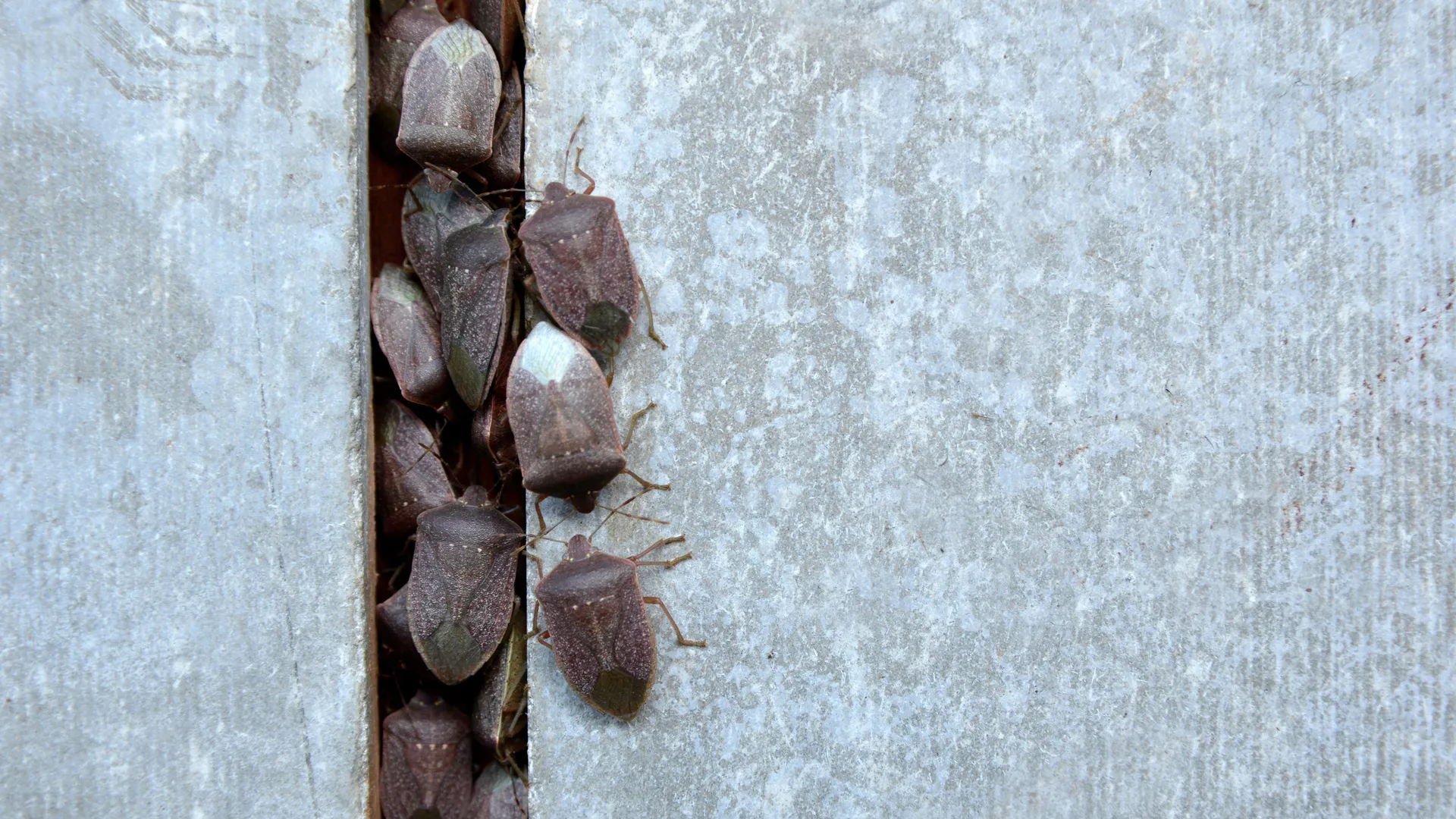
Bugs hunt for somewhere to spend the winter, and on a cool October afternoon, the sunny side of your house is the warmest surface around. Stink bugs and boxelder bugs pile onto warm siding, Asian lady beetles do the same, and then they all start working into the gaps around windows and vents. Once inside a wall or attic, they go quiet until the first warm stretch of late winter wakes them up. Killing the ones you see indoors changes nothing, because the population that matters is still outside on the wall. The fix is treating the exterior before they move in.
Walk out to the driveway on a mild October afternoon and the south wall of the house is covered in bugs. Shield-shaped brown insects sitting flat against the warm siding, orange beetles crowded around a window frame, black and red bugs packed into the seam where brick meets trim.
Nobody sees this in July. It starts once overnight lows hit the forties, and by the time someone finds stink bugs in the house, that wall has usually been covered for a while.
Telling the Three Apart
Stink bugs are the flat, shield-shaped brown ones, roughly the size of a thumbnail, and clumsy enough in the air that they bounce off windows. Boxelder bugs are narrower and black, with thin red lines down their backs, and they're heaviest near boxelder and maple trees, so older, tree-lined neighborhoods often see the most of them.
Asian lady beetles look like the ladybugs from a kid's book but come in colors from mustard to deep orange, with an M-shaped mark behind the head. Getting the name right matters less than people expect. All three want the same thing from your house, and you handle all three the same way.
Why They Pick Your House in October
Warmth is most of the answer. These insects spend the warm months in trees and fields, and once nights turn cold, they move toward whatever surface holds heat longest, usually the south or west wall. Lady beetles are also drawn to light-colored siding, the outer covering on the wall, so pale houses often collect more of them than dark ones.
Older homes make it worse: settled frames, original wood windows, and storm windows that no longer sit tight. Around Livonia and the surrounding neighborhoods, most homes were built before 1980, and many of them have gaps a boxelder bug can walk straight through.
How Stink Bugs Get in the House
They do not chew anything. They walk in through openings that already exist:
- Gaps under worn weatherstripping, the rubber seal along a door or window edge
- Bathroom and dryer vents with no screen behind the flap
- Anywhere the soffit, the flat underside of the roof overhang, meets the wall
- Torn window screens
Once they are past the wall, they head for a quiet, protected space and shut down for the winter. Attics are the usual spot. The hollow space inside a wall works just as well, and so does the dead air above a bay window.
Why Indoor Sprays Do Not Help
You can empty a can of household spray along a baseboard and kill every bug in the room. The next warm afternoon, a dozen more come out of the ceiling light fixture. The ones indoors are a small fraction of what is sitting on the wall outside, and the ones in the walls are past the point where any spray reaches them.
Vacuuming is the better indoor move, and for stink bugs it beats crushing them, since crushing is what releases the smell that gives them their name. It clears out the ones that got in, but it does nothing about the ones still on the wall.
The Best Time to Treat Is Short
Exterior treatment works while the insects are still outside of the house. Once they are inside a wall, the only thing left to do is wait them out and vacuum up the ones that wander into the living space until they leave in spring.
In Michigan, the best time to treat is from about mid-September to the first hard freeze, so it pays to book early instead of waiting until ladybugs are in the house at Thanksgiving. Last fall's treatment won't stop this year's bugs.
What Our Exterior Treatment Covers
Our general pest control service is built around the outside of the home, because that is where these insects gather. Here is what a visit includes:
- The full exterior perimeter, every side of the house and not just the front
- We treat the eaves, the overhang where the roof extends past the wall, where most companies stop at the lower perimeter instead
- Attention to the spots these bugs use to get in, like window and door frames, vents, and soffit seams
- Interior treatment on request, though for these insects it is rarely the part that fixes anything
Spraying the eaves matters most here, because that overhang is where many lady beetles and boxelder bugs gather before slipping into the attic.
Pricing and Our Guarantee
The exterior and eaves treatment comes with both of our general pest plans: Pest 4, four visits a year starting at $49 a month, and Pest 6, six visits a year starting at $69 a month for homes with heavier pest activity. Pricing is flat across the Detroit metro area, so a house in Ortonville pays the same as a house in Westland, with no travel fee or zip code markup.
Every plan includes our 100% satisfaction guarantee, backed by free re-services: if pests come back between visits, we'll return at no extra charge. We also aim to send the same professional on your repeat visits, so nobody has to re-explain which wall gets hit every year.
Ready for the Next Warm Afternoon?
If the siding is already covered, you still have time to treat it before the first hard freeze. Call us at (833) 378-0537 or send us a message, and we will get one of our professionals out, usually within two to five business days.
We serve homeowners across the Detroit metro area, including:
- Westland
- Livonia
- Farmington Hills
- Royal Oak
- Warren
- Romeo
- Chesterfield
- Oxford
- Ortonville
- Fenton
- Parshallville
- Brighton
- Whitmore Lake
- Barton Hills
Do not see your city? Give us a call. We probably cover you too.